 TakeHomePay
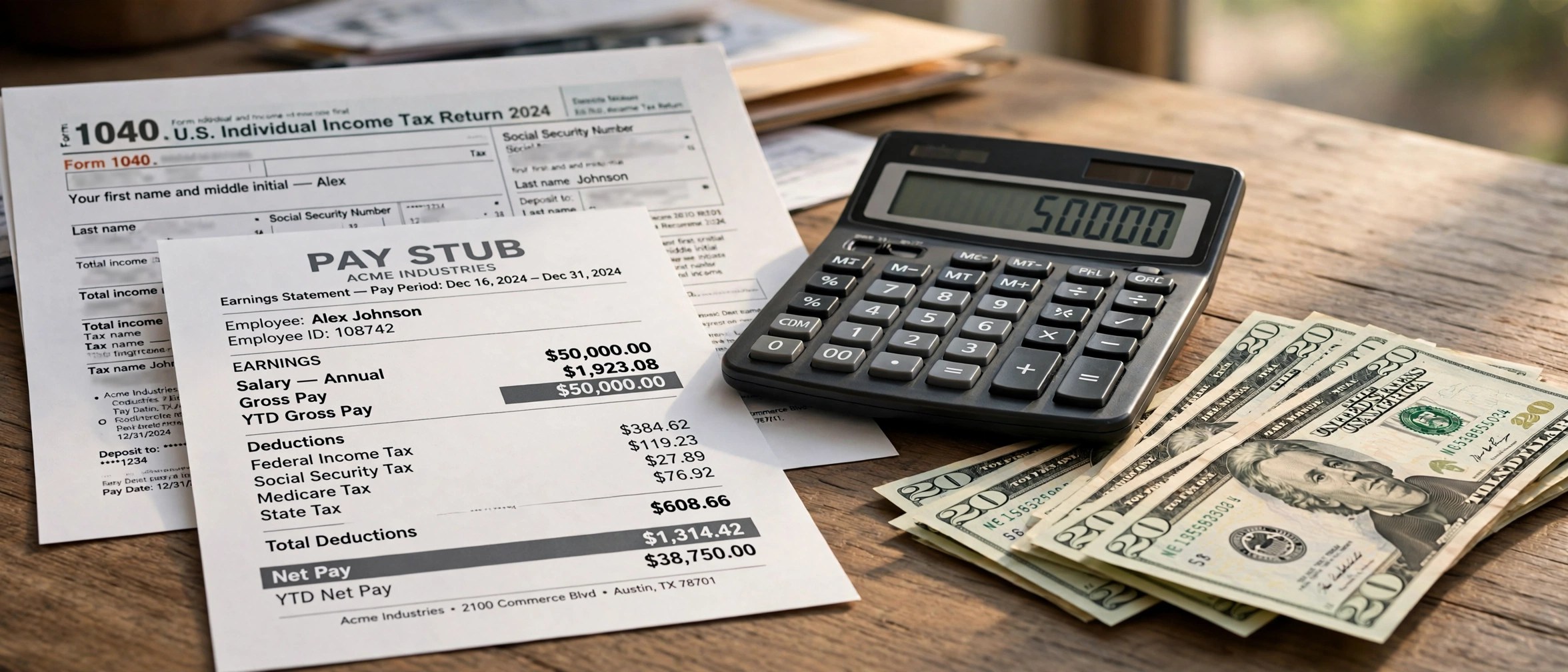
How Much Is $50,000 After Taxes? Take-Home Pay (2026)
Key takeaways
- A single filer on $50,000 keeps $42,355 a year in a state with no income tax, and about $40,910 in a typical state — the median across all 50.
- The total tax bill before state tax is $7,645: $3,820 in federal income tax plus $3,825 in Social Security and Medicare. Payroll taxes cost slightly more than income tax at this salary.
- Per paycheck, that is $3,529.58 a month, $1,629.04 biweekly, or $814.52 a week — before 401(k), health insurance, or state tax.
- Your state is the swing factor: Oregon takes about $3,204, New York about $2,103, California about $973, and Texas and Florida take nothing.
- Filing jointly on the same $50,000 keeps $2,040 more a year than filing single, because the joint standard deduction is twice as large.
In this guide
- The short answer
- The federal breakdown, line by line
- FICA: payroll taxes cost slightly more than income tax
- What your state takes
- Your $50,000 paycheck, per check
- Married vs single — and head of household
- Why your paycheck might not match
- What a raise to $55,000 actually keeps
- How to keep more of it
The short answer
A $50,000 salary works out to about $962 a week. The Bureau of Labor Statistics reported median weekly earnings of $1,251 for full-time wage and salary workers in the second quarter of 2026, about $65,000 a year, so $50,000 sits below the median. Here is the take-home math for a single filer in 2026 with no pre-tax deductions:
| Amount | |
|---|---|
| Gross salary | $50,000 |
| Federal income tax | −$3,820 |
| Social Security (6.2%) | −$3,100 |
| Medicare (1.45%) | −$725 |
| Take-home, no state tax | $42,355 |
| Take-home, typical state (median) | ≈ $40,910 |
That is an effective total tax rate of about 15.3% before state tax, and about 18.2% in a median-tax state. Every number below is computed from the 2026 federal schedules (IRS Rev. Proc. 2025-32) and our full $50,000 salary breakdown, so you can check each one; FICA rates are from IRS Topic 751. If you want your exact state and filing status, the take-home pay calculator runs the same math for you.
The federal breakdown, line by line
$50,000 is a good salary for learning the difference between a marginal rate and an effective rate. First, the $16,100 standard deduction (more in our guide to the 2026 federal tax changes) comes off the top, leaving $33,900 that the IRS actually taxes. That slice is split across two brackets — it is not taxed at one flat rate. The first $12,400 is taxed at 10% ($1,240), and only the remaining $21,500 is taxed at 12% ($2,580), for a total federal bill of $3,820.
| Bracket | Taxable income range | Income in bracket | Tax |
|---|---|---|---|
| 10% | $0 – $12,400 | $12,400 | $1,240 |
| 12% | $12,400 – $33,900 | $21,500 | $2,580 |
| Total federal income tax | $3,820 |
Your marginal bracket is 12%: an extra dollar you earn is taxed at 12%. But your effective federal rate across the whole salary is just 7.6%. At this salary, no one pays the 12% bracket rate on their whole income, so a $50,000 salary is not "taxed at 12%": the 12% describes only the top slice. Our 2026 federal brackets guide walks through all seven rates if you want the full picture.
FICA: payroll taxes cost slightly more than income tax
At this salary, payroll taxes edge out income tax. Social Security collects 6.2% of every wage dollar with no deduction and no brackets — $3,100 on this salary — and Medicare adds another $725 at 1.45%. Combined FICA of $3,825 is slightly more than the $3,820 federal income tax, which is why the total bite feels larger than the "12% bracket" label suggests.
| Payroll tax | Rate | Amount |
|---|---|---|
| Social Security | 6.2% | $3,100 |
| Medicare | 1.45% | $725 |
| Total FICA | $3,825 |
Both payroll taxes apply to the full $50,000 because the Social Security wage cap ($184,500 in 2026) is far above this salary, and the additional 0.9% Medicare tax only starts at $200,000 for single filers. Unlike income tax, the standard deduction does not soften FICA — it starts on dollar one. A 401(k) contribution cuts your income tax but not your FICA, while payroll-deducted health premiums and HSA contributions are the exceptions that do reduce it (more below). If you are self-employed you pay both halves: self-employment tax is 15.3% of 92.35% of net earnings, about $7,065 on $50,000 (IRS Topic 554).
What your state takes
At $50,000, state income tax can move your take-home by a few thousand dollars. The table below shows a spread of states, from no-tax states to the heaviest state bite, computed the same way as our state pages:
| State | 2026 state income tax | Take-home pay |
|---|---|---|
| Texas, Florida (no income tax) | $0 | $42,355 |
| Ohio | $933 | $41,422 |
| California | $973 | $41,382 |
| New Jersey | $1,215 | $41,140 |
| North Carolina | $1,486 | $40,869 |
| Pennsylvania | $1,535 | $40,820 |
| Georgia | $1,747 | $40,609 |
| New York (state only) | $2,103 | $40,252 |
| Illinois | $2,330 | $40,025 |
| Oregon | $3,204 | $39,151 |
Nine states — Alaska, Florida, Nevada, New Hampshire, South Dakota, Tennessee, Texas, Washington, and Wyoming — levy no income tax on wages, so the $42,355 figure holds in all of them before local or payroll-program deductions. The spread from Texas to Oregon is $3,204 a year, about $267 a month (here is how Oregon's tax works). Two caveats: New York City residents pay a city tax on top of the state figure (our NYC guide stacks all four layers), and Pennsylvania local earned-income taxes, which vary by municipality, are not in the state figure. For every state at once, the Salary Showdown ranks all 50 for your exact salary, our best-states ranking compares them at $100,000, and our $50,000 salary page has the full breakdown. Individual state pages — California, New York, Texas — show each state's own math.
California needs a footnote, because it explains a lot of confusion online: the $41,382 above is after California income tax only. California also deducts State Disability Insurance at 1.3% of wages (EDD's 2026 rate), with no wage cap since 2024 — $650 on a $50,000 salary — which is a payroll deduction, not an income tax. Count it, and the cash in a California paycheck is $40,732. If you have seen a lower California number elsewhere, that $650 is the usual difference; some calculators also use different California assumptions that land a few hundred dollars away. Our table keeps income tax and SDI in separate buckets so you can see exactly what each one costs.
Here is the California income tax line by line. After the $5,900 standard deduction, taxable income is $44,100, spread across four brackets, and the $158 personal exemption credit comes off the result (per the California Franchise Tax Board):
| California bracket | Income in bracket | Tax |
|---|---|---|
| 1%: $0 – $11,456 | $11,456 | $114.56 |
| 2%: $11,456 – $27,157 | $15,701 | $314.02 |
| 4%: $27,157 – $42,861 | $15,704 | $628.16 |
| 6%: $42,861 – $44,100 | $1,239 | $74.34 |
| Less personal exemption credit | −$158.00 | |
| California income tax | $973.08 |
Your $50,000 paycheck, per check
The per-check number is what you budget with, not the annual one. Before any 401(k), health insurance, or other deductions — and in a state with no income tax — a $50,000 salary breaks down like this:
| Pay frequency | Take-home per check |
|---|---|
| Monthly (12/year) | $3,529.58 |
| Semimonthly (24/year) | $1,764.79 |
| Biweekly (26/year) | $1,629.04 |
| Weekly (52/year) | $814.52 |
On an hourly basis, $50,000 a year works out to about $24.04 an hour gross across a standard 2,080-hour year — and about $20.36 an hour after federal tax and FICA, before state tax. If you are comparing this salary against an hourly offer, that net hourly figure is the fair comparison. Our hourly pay calculator runs it for any wage, and our $25-an-hour guide works the same math from the other direction: $52,000 a year keeps $43,962 with no state tax. To convert to other schedules, use the pay frequency calculator.
For a quick budget reality check, take the familiar 30% rent rule against the no-state-tax monthly figure: $3,529.58 leaves about $1,059 for rent and $2,471 for everything else. In a median-tax state the monthly figure is about $3,409, so the same rule gives roughly $1,023 for rent. Test that number against actual listings in your city rather than a national average: $1,059 covers a lot in some places and very little in others.
Married vs single — and head of household
Filing status changes the tax on this salary a lot. A married couple filing jointly on a single $50,000 income gets a $32,200 standard deduction — double the single amount — so only $17,800 is taxable, and all of it sits inside the joint 10% bracket (which stretches to $24,800). Federal tax falls to $1,780, and take-home pay rises to $44,395 with no state tax: $2,040 a year more than the single filer's $42,355, or $170 a month. FICA does not change — it is per person, per wage dollar, regardless of filing status. Our married vs single guide works the same comparison at $75,000, where the gap is $3,030.
Head of household sits in between: a $24,150 standard deduction leaves $25,850 taxable, taxed at 10% on the first $17,700 ($1,770) and 12% on the remaining $8,150 ($978), for $2,748 in federal tax and $43,427 take-home with no state tax — $1,072 more than filing single. If you are unmarried and pay more than half the cost of keeping up a home for a qualifying person, such as a child, head of household may apply to you. Credits such as the Child Tax Credit come on top and are not included in these figures.
Why your paycheck might not match
If your stubs show less than $1,629 biweekly, that does not mean this math is wrong. Four things usually explain the gap, and two of them are choices rather than taxes:
- Your W-4 controls withholding, not your final tax. Each paycheck's federal withholding is your employer's estimate from the W-4 you filed. The numbers here are the actual 2026 tax; any gap between withholding and reality is settled as a refund or a balance due at filing time.
- Benefits come out first. Health insurance premiums, dental and vision plans, and traditional 401(k) contributions are typically subtracted before income tax is calculated. They lower your taxable income (good at tax time) but they also lower the spendable amount per check. Premiums paid through an employer cafeteria plan also reduce FICA wages; 401(k) deferrals do not.
- Local taxes exist in some places. New York City, Yonkers, and many Ohio and Pennsylvania localities levy their own income taxes, which sit outside the state figures in the table above.
- State withholding is an estimate too. Your state stub line is your employer's estimate under that state's tables; the return settles it, just like the federal one. A few states, including New York and Washington, also deduct paid-family-leave or disability premiums that the figures above do not include.
To read a stub that looks light, add up the federal, FICA, and state lines, compare them with the table at the top of this guide, and treat the rest — benefits, retirement, local tax — as separate buckets. A benefits deduction is not a tax, and it is easy to blame the wrong line.
What a raise to $55,000 actually keeps
A $5,000 raise does not add $5,000 to your pay. At $55,000, taxable income rises to $38,900, and the extra $5,000 is taxed at your 12% marginal rate ($600) plus 7.65% FICA ($382.50). You keep $4,017.50 of the raise — about 80 cents on the dollar — and your take-home pay rises from $42,355 to $46,372.50 with no state tax. The same marginal math is why a bonus can feel smaller than expected; our bonuses guide shows how the 22% withholding rule interacts with it. Raises are still worth taking: the tax system takes a slice of each new dollar, not the whole dollar.
| Raise to | Extra salary | Extra federal tax | Extra FICA | You keep |
|---|---|---|---|---|
| $55,000 | $5,000 | $600 | $382.50 | $4,017.50 (80.4%) |
| $60,000 | $10,000 | $1,200 | $765 | $8,035 (80.4%) |
| $65,000 | $15,000 | $1,800 | $1,147.50 | $12,052.50 (80.4%) |
| $70,000 | $20,000 | $2,750 | $1,530 | $15,720 (78.6%) |
Above a $66,500 salary, each new dollar is taxed at 22% federal instead of 12%, so you keep a little less of it; our $60,000 salary guide shows where that lands. All figures are single filer, no state tax.
How to keep more of it
No legitimate move makes $50,000 tax-free. These are the ones that change the number:
- Put 6% in a traditional 401(k). A $3,000 pre-tax contribution drops taxable income from $33,900 to $30,900, cutting federal tax from $3,820 to $3,460 — a $360 saving this year — while the $3,000 itself goes into retirement. Cash in hand falls to $39,715, but total value kept rises to $42,715. FICA does not fall; it never does on 401(k) money.
- Use an HSA through payroll if you have a high-deductible plan. HSA contributions made through payroll skip both income tax and FICA, which makes them the rare deduction that beats a 401(k) on payroll tax. The 2026 limits are $4,400 for self-only coverage and $8,750 for family coverage (IRS Rev. Proc. 2025-19), and employer contributions count toward them.
- Check your W-4 once a year. A big refund is your own money coming back after the IRS held it all year without paying interest. A corrected W-4 puts more of it in each paycheck.
- Location moves the number most. Moving from Oregon to a no-tax state on the same salary saves $3,204 a year, roughly nine times the $360 a 6% 401(k) contribution saves in federal tax. That is a life decision rather than a tax tip, and housing costs belong in it.
Run your own numbers — any salary, any state:
Try the Take-Home Pay Calculator →Figures are 2026 estimates computed from the 2026 federal rate schedules (Rev. Proc. 2025-32), Social Security and Medicare rates, and state revenue department schedules — not tax advice. Assumes a single filer with wage income, standard deduction only, no pre-tax deductions unless noted. State withholding, credits, itemized deductions, local taxes, and the additional Medicare tax will change your actual take-home pay. Consult a tax professional for your situation.
The bottom line
A $50,000 salary keeps $42,355 with no state tax and about $40,910 in a typical state, after $3,820 in federal income tax and $3,825 in payroll taxes. That is $3,529.58 a month, $1,629.04 biweekly, or $814.52 a week — before state tax, benefits, and retirement. The two things most people get wrong about this salary are the bracket (12% is the top slice, not the whole salary; the real federal rate is 7.6%) and the payroll taxes (FICA costs more than income tax here, and it starts on dollar one). File jointly and the same salary keeps $2,040 more; get a $5,000 raise and you keep $4,017.50 of it. The rest is your state's call.
Keep reading


Frequently asked questions
How much is $50,000 a year after taxes?
A single filer keeps about $42,355 a year in a state with no income tax, and about $40,910 in a typical state (the median across all 50). That is after $3,820 in federal income tax and $3,825 in Social Security and Medicare taxes, before any state tax, 401(k), or health insurance deductions.
How much is $50,000 a month after taxes?
About $3,530 a month in a state with no income tax ($42,355 divided by 12). In a typical state the median is about $3,409 a month. Your actual monthly pay depends on your state and your pay frequency.
How much is $50,000 biweekly after taxes?
About $1,629 per biweekly paycheck in a state with no income tax ($42,355 divided by 26 pay periods), before 401(k) or health insurance deductions. Weekly pay works out to about $815 per check.
Is a $50,000 salary taxed at 12%?
Only partly. Your marginal rate is 12%, but it applies only to income above the 10% bracket. Thanks to the $16,100 standard deduction and the 10% bracket underneath, your effective federal rate is about 7.6%.
What do Social Security and Medicare cost on $50,000?
$3,100 for Social Security and $725 for Medicare, $3,825 combined. That is slightly more than the federal income tax on this salary, because payroll taxes have no standard deduction and no brackets.
How much tax is taken out of a $50,000 salary in California?
About $973 in California state income tax for a single filer in 2026, leaving take-home pay of about $41,382 after federal tax and FICA. New York takes about $2,103, leaving about $40,252; Oregon takes about $3,204, leaving about $39,151.
Does filing jointly change take-home pay on $50,000?
Yes. A married couple filing jointly on a single $50,000 income pays $1,780 in federal tax instead of $3,820, because the joint standard deduction is $32,200 and the 10% bracket stretches to $24,800 of taxable income. Take-home pay rises to $44,395 with no state tax, $2,040 a year more than the single filer's $42,355.
Is $50,000 a good salary?
It depends mostly on where you live. $50,000 is about $962 a week, below the $1,251 median weekly earnings the Bureau of Labor Statistics reported for full-time wage and salary workers in the second quarter of 2026 (about $65,000 a year). After tax, a single filer in a state with no income tax keeps about $3,530 a month.
How much is $50,000 a year per hour after taxes?
About $24.04 an hour before tax over a 2,080-hour year, and about $20.36 an hour after federal income tax and FICA in a state with no income tax. State income tax lowers that further.
How much is $50,000 after taxes if you are self-employed?
Self-employment tax is 15.3% of 92.35% of net earnings, about $7,065 on $50,000, compared with $3,825 in FICA for an employee, because you pay both halves. Federal income tax is separate, and half of the self-employment tax is deductible, so exact take-home depends on your deductions.